The Boulder Rolls Back
There is a moment every surgeon knows. The monitors are screaming, the team is moving with a precision born from thousands of hours of training, and somewhere between the third and fourth unit of blood the room goes quiet in a way that has nothing to do with sound. The patient is dying. Not because anyone made a mistake. Not because anything was missed. The body simply decided it was done, and no amount of skill, technology, or desperate will could overrule that decision.
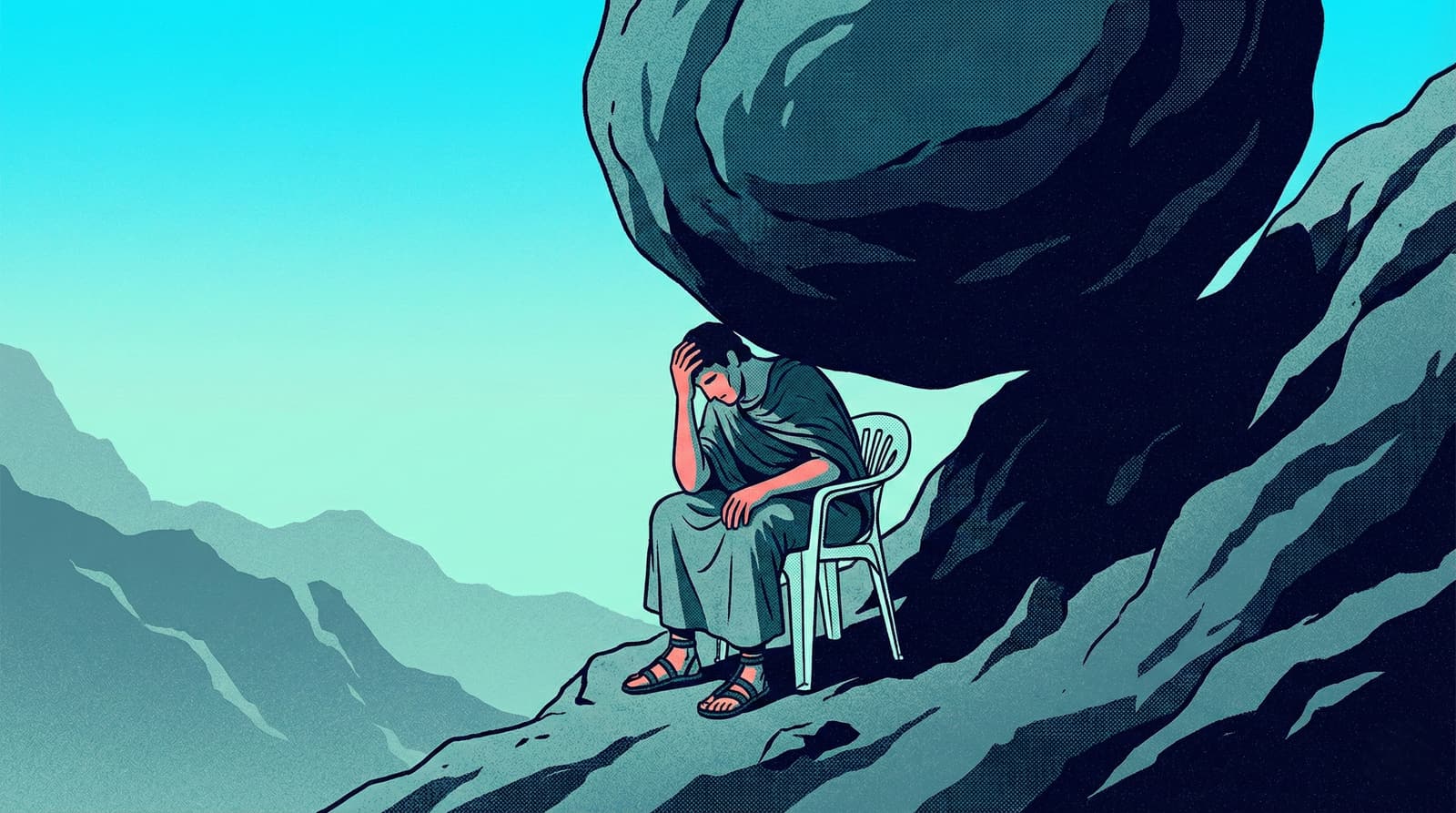
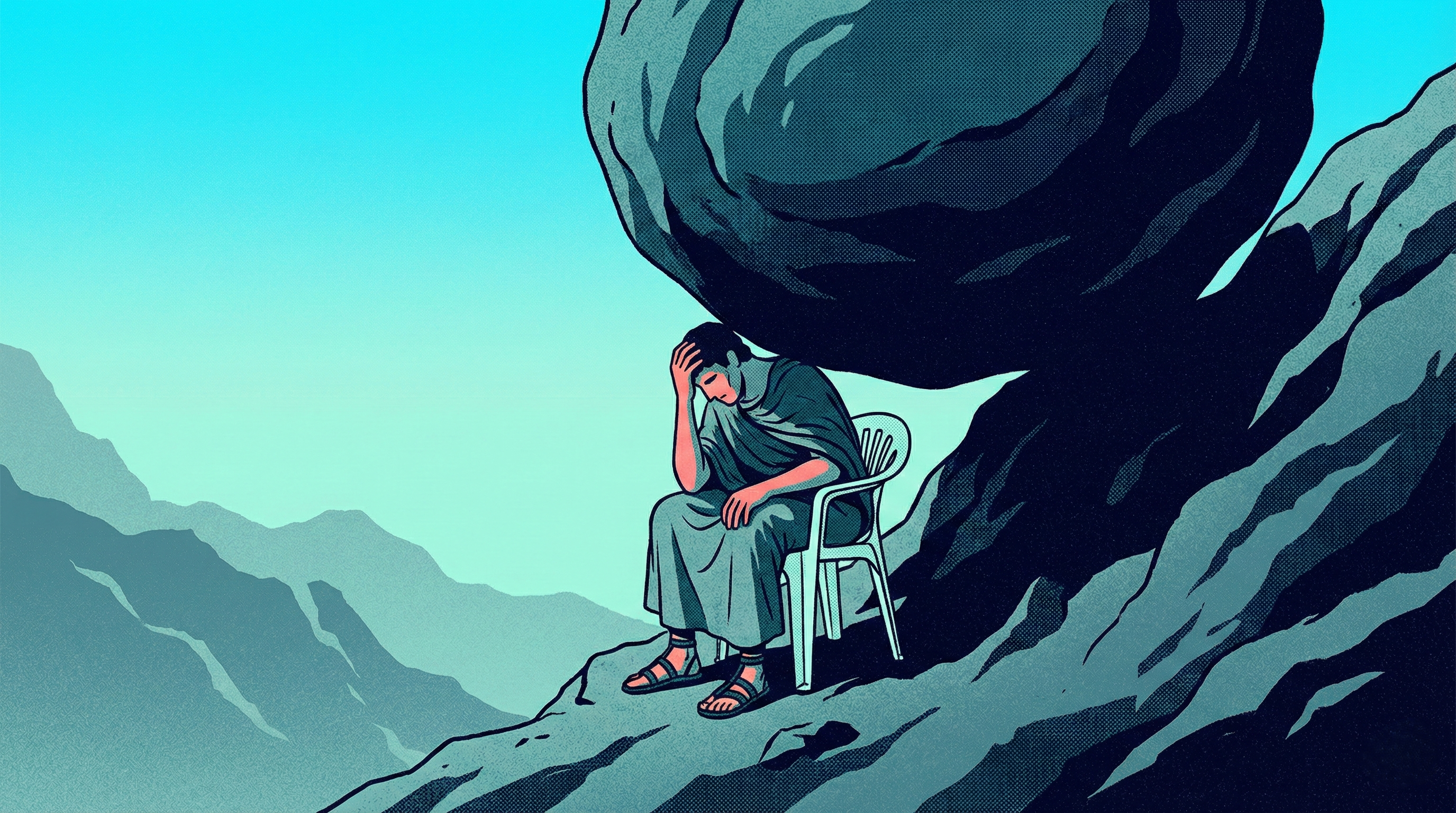
Camus told us we must imagine Sisyphus happy. It is one of the most quoted lines in modern philosophy, and one of the least understood. People reach for it when they want permission to find meaning in repetition — the commute, the laundry, the Monday morning inbox. It has become a motivational poster. Keep pushing. Find joy in the grind. The boulder is the point.
But Camus was not writing a self-help book. He was staring into something genuinely terrifying, and he flinched. Not much — Camus rarely flinched — but enough. Because the real horror of Sisyphus is not the repetition. It is the certainty. The boulder will always come back down. Always. Not because Sisyphus is weak, or because he pushes wrong, or because he hasn't yet found the optimal angle of approach. The gods have designed a system in which victory is structurally impossible. The game is rigged at the level of physics itself.
And Camus looked at that and said: be happy anyway.
I want to look at it and ask a different question. Not whether Sisyphus can be happy — but what happens to us when we encounter our own rigged games and refuse to admit what they are.
The Moments That Don't Fit the Story
We have built an entire civilisation on the premise that effort correlates with outcome. Work hard, get rewarded. Train well, perform well. Prepare thoroughly, succeed accordingly. The narrative is so deeply embedded that when it breaks, we don't update the narrative — we blame the person. The surgeon should have caught it earlier. The captain should have turned sooner. The politician should have negotiated harder.
But there are categories of failure that have nothing to do with competence.
A ship captain in heavy weather can do everything right. Reduce speed, alter course, ballast correctly, communicate with the coastguard, brief the crew. And the sea can still win. Not because the captain failed, but because a forty-year-old hull meets a once-in-a-century wave at precisely the wrong angle, and steel does what steel does under forces it was never designed to meet. The captain drowns alongside the deckhand. Skill is irrelevant. Experience is irrelevant. The sea was not listening.
A politician sits across the table from a warlord who has already decided to invade. The diplomat offers concessions, frameworks, timelines, guarantees. Every tool of statecraft, deployed with genuine skill. The warlord smiles, signs nothing, and sends the tanks at dawn. Was the failure in the negotiation? Or was the negotiation always a performance — a ritual whose outcome was sealed before the first handshake?
A parent watches a child spiral into addiction. They try patience. They try firmness. They try therapy, boundaries, unconditional love, conditional love, silence, presence, distance. None of it works. Not because the parent is doing it wrong, but because the child's brain chemistry has been hijacked by a molecule that does not care about love.
These are not stories of insufficient effort. They are stories where the universe has placed the summit just beyond the reach of any possible push.
The Boogeyman Under the Bed
Here is what I think we are actually afraid of.
Not failure itself — we have made peace with failure. There are entire industries built on reframing failure as learning, as growth, as the necessary precondition for success. Fail forward. Fail fast. Failure is just data. We have domesticated failure so thoroughly that it barely qualifies as a threat anymore.
What we have not domesticated is futility.
Failure says: you tried and it didn't work, so try differently. Futility says: you tried and it didn't work, and trying differently would also not have worked, and trying harder would also not have worked, because the architecture of this particular situation does not contain a path to the outcome you wanted.
That is the monster under the bed. Not that we might lose, but that in certain moments, on certain days, in certain operating theatres and wheelhouses and negotiation rooms, we were always going to lose. That our effort, however maximal, however skilled, however heroic, was from the very start a gesture made into a void that could not receive it.
We know it is there. We have always known. And we keep our feet firmly on the mattress.
The surgeon does not say: "There was nothing anyone could have done." The surgeon says: "I should have caught the bleed sooner." The captain does not say: "The sea was beyond any vessel's capacity." The accident report identifies contributing factors, procedural gaps, missed opportunities. We construct elaborate causal chains that lead backward from catastrophe to some identifiable human error, because the alternative — that sometimes catastrophe arrives unbidden and undeserved — is a thought too large to hold.
This is not cowardice. It is survival. If the surgeon accepts that some patients will die regardless, does she lose the edge that saves the ones who can be saved? If the captain accepts that some seas are unsurvivable, does he become careless in the seas that merely require competence? The illusion of control is, in many professional contexts, a functional necessity. The fiction keeps us sharp.
But it is still a fiction. And there is a cost to maintaining it.
The Walk Back Down
Camus spent the most interesting paragraph of The Myth of Sisyphus not on the push upward but on the walk back down. After the boulder escapes, after the summit has once again proven unreachable, Sisyphus turns and descends. It is in this moment, Camus writes, that Sisyphus is conscious. He knows what has happened. He knows what will happen next. And he walks down anyway.
This is where I think Camus was actually onto something enormous — and then veered away from it.
The walk back down is not about happiness. It is about something much older and much stranger. It is about the human capacity to act in the full knowledge that the action will not succeed. To push the boulder not because it might stay this time, not because repetition will eventually crack the code, but because pushing is what you do when you are Sisyphus and there is a boulder and there is a hill.
The surgeon scrubs in for the next surgery. The captain takes the next watch. The diplomat returns to the table. Not because they have forgotten what happened last time, and not because they believe next time will be different. But because the alternative — to sit at the bottom of the hill and refuse to climb — is not actually available to them. Not psychologically. Not morally. Not practically.
This is not optimism. Optimism believes the boulder might stay. This is something else entirely. Something that does not have a clean name in English, though the Stoics circled it, and the Zen Buddhists poked at it, and every culture that has sent people to war or to sea has had to develop some working vocabulary for it.
It is the act of showing up for a game you know you cannot win, and playing it as though you can, without the delusion that you will.
The Beauty and the Shadow
So is there beauty in this? I have gone back and forth.
There is something undeniably magnificent about the surgeon who walks into the operating theatre for the ten-thousandth time, carrying the memory of every patient lost, and still performs with the concentration and care of someone who believes this one can be saved. There is something about the lifeboat coxswain who launches into seas that may kill him, not because he is certain he can reach the casualty, but because not launching is unthinkable. There is a grandeur in that. A defiance that has nothing to do with probability.
But I am suspicious of calling it beautiful, because beauty has a way of making things acceptable. And some of this should not be made acceptable. A child dying of leukaemia despite flawless treatment is not beautiful. It is not ennobling. It is not a gift wrapped in suffering. It is a child dying, and the universe not caring, and a team of highly trained professionals standing in a room with empty hands.
Perhaps the honest answer is that it is both. That the shadow and the beauty are not two separate things but the same thing seen from two distances. Up close, it is horror. From a step back, it is the most human thing we do — continuing to act in conditions that do not justify action. From a step further back, it is the only thing we have ever done. Every civilisation, every art form, every act of love is performed against the backdrop of guaranteed eventual annihilation. We build sandcastles below the tide line. We always have.
Sisyphus Was Not Brave
I want to return to the title, because I think it matters.
We call Sisyphus brave, or absurd, or heroic, or wise. Camus called him happy. The self-help industry calls him resilient. But Sisyphus was none of these things by choice. He was condemned. His situation was not an attitude he adopted but a sentence he was serving. He did not choose to push the boulder. He chose nothing. The gods chose for him.
And this, finally, is where the myth breaks — and where real life begins. Because the surgeon can walk away. The captain can resign. The diplomat can retire. The parent can stop answering the phone. Real people, unlike Sisyphus, have the option of sitting down.
The fact that they don't — the fact that they keep pushing a boulder they know will roll back, in a game they know they cannot ultimately win, when they are fully free to stop — is not something Camus's framework quite captures. It is not rebellion against the absurd. It is not happiness in spite of futility. It is something quieter and harder to name.
Maybe it is simply this: that we are the kind of animal that pushes boulders. Not because the gods force us. Not because we think the boulder will stay. But because there is a hill, and we are here, and the boulder is not going to push itself.
And maybe that is enough. Not beautiful, not noble, not meaningful in any cosmic sense. Just enough. The way a heartbeat is enough. The way breathing is enough. Not a triumph. Not a tragedy. Just the thing that happens when you are alive and there is work to be done and you have not yet found a good enough reason to sit down.
The monster under the bed is real, by the way. I looked.
It looks a lot like a mirror.